
 Hey! Welcome to my blog! You can take some time to get to know me by reading posts under the "Who Am I?" category or you can just get started by reading topics you would like to learn about.
Ok. Let me state again, I have a lot of understanding and respect for the agnostic position, because I know of the difficulty in believing something that can’t be proven with tangible evidence. But like I said before, the purpose here is not to produce evidence of a God. Simply put, my objective is to show logically, if there is a God and he is the God that the Christian scriptures say he is, what one can do to reduce their risk when the time comes that an individual comes to find out.
As stated in the last segment, Jesus Christ showed us the way to do so, namely, humility and prayer. Humility, meaning subjecting one’s self to the will of the God.
 I will discuss here, the idea that it’s more worth it to just risk living as though there was no God due to fact that living the Commandments of the Holy Bible and trying to live a Christ-like life style is too hard and infringes on an individual’s freedoms.
Let me say this first. That is no “fact” at all. Yes, it is hard work. But too hard? No. Yes you sacrifice a lot of temporary pleasures. But give up freedoms? Not in the slightest.
Now, you may think that those statements were biased. But I can say will a clear conscience that they are not, because I have not always lived the commandments before I became a believer, and even then, I still believed those statements. And although on the surface they seem defensive or emotional, they are actually logical. Let me show you what I mean.
Let’s talk about the idea that it is too hard first, because it is the less controversial of the two. A true believer and follower of the Holy Bible understands that the way is narrow, and the gate is strait. They also understand that the gate is so strait (notice the spelling is not straight but “strait,” meaning that it is “narrow” or “strict”) that we of ourselves cannot enter because of our baggage of worldliness.
 But the key here is understanding that we need not worry ourselves of this because God knew this would be so, and provided a Redeemer on or behalf on conditions of repentance. This continual repentance, if done sincerely constitutes a desire to change and an effort to match. If done in this way, it matters not that one become baggage-free to enter the gate, it only matters that we tried our best in order to let Christ into our lives and let him do the rest. Hard it may be, but too hard? How can it be too hard if the amount of progress is not measured, only the amount of effort put in? It is never too hard for me to try my best. Nor can it be too hard for you to try your best. Trying to live a Christ-like life is hard work, but it is not so hard that it isn’t worth it.
So what of the limitations and restrictions? What about those who say “that the gate shouldn’t be strait at all and you shouldn’t really need to have a change of heart (real repentance) to receive the eternal reward. Living by commandments is too restrictive and is not what a good God would want for his Children.” Let me answer both of those concepts with an analogy.

 If you were covered in mud, would you feel comfortable walking around inside someone’s home which is perfectly white and all of the house guests are wearing white clothes and white socks to keep dirt outside? Wouldn’t you feel uncomfortable bringing in heaps of the very thing that everyone in the house was trying to keep out? Wouldn’t that be constantly on your mind as you walked around in their presence? Let me further demonstrate the point with another similar analogy.
This time imagine a home of perfect obedience and knowledge, you live with all your family and friends, and you are very happy living there in purity. Then the Father of the home tells you it’s time for you to receive your inheritance. This inheritance is for you to go to college and when you are finished to come home and he’ll reward you for your efforts of learning and for bringing honor to the family name.  Your degree is simply to learn as much as you can about controlling your body and improving your talents in any way you can in the space of a designated amount of time. Your reward is infinite progression with limitless capabilities beyond all comprehension.
The Father of the home tells you that “there will be many challenges, some will try and stop you from reaching your potential of learning these things—from obtaining your degree. They will do so by offering you fun, pleasure, gratification, thrills and excitement in its place.” If you fall into this trap, you won’t be able to obtain the very thing which you set out for.
 So now, imagine again, if you fall in with the crowd, and don’t obtain that which you set out for, do you think the Father will love you any less? No. But would you feel comfortable in his presence when you both know that you just wasted your time and potential on temporary things. You think you would feel justified in receiving that reward when you know you didn’t earn it? If you have a conscience and you honestly answer that question, you know the answer would be no.
That is what a change of heart is all about. It is about getting to a point where you feel comfortable dwelling in the presence of a perfect God—both all knowing and just, yet still merciful always. If you repent, and desire to change, and desire to improve your self-control then you will want to do those other things less and less. And as you work at it as best as you can you will be doing what God asked of you, unlocking his promise that He will make up what you lack. This peace of mind—developed out of a sense of knowing that you are doing what you have been asked to do—will cause you to feel comfortable in his perfect and holy presence.
This is why God gives us commandments, to designate which path brings us closer to him, and which path would keep us from that end. Keeping Commandments bring happiness because it brings an assurance that one is on the correct path.  Breaking Commandments on the other hand, although may bring fun and gratification for a time, ultimately brings about misery and guilt when one stops to think about where they would actually feel more comfortable having a knowledge that they have wasted their inheritance; would that person feel more comfortable in the presence of a perfect God, or in the presence of another master—the world? Seems their actions point to the latter; that would be an awful feeling don’t you think?
Do commandments restrict freedom? No. A man is free to choose his own path. He may choose to spend his inheritance on the things of the world, or he may choose to get his “degree.” He may choose to keep or break commandments. God does not force anyone to live his commandments; he only reveals the consequences—good or bad—for choosing either side. If someone chooses to follow the commandments, that person does sacrifice something, but they do so with a belief that that sacrifice ultimately leads to an infinite reward. It is their choice, which brings them happiness.
If you are still not convinced and say that the rules are too restrictive let me ask you a question? What is someone restricted from; substances, gambling, sexual behavior outside the bonds of marriage? Ok. Should I list all of the potential problems that can come from those things? Or how about listing all the temporal blessings (not even counting the spiritual blessings one believes they recieve) that come from living those commandments? Or maybe I didn’t bring up the right commandments? Is there something that I didn’t list that is so important that it is just so great and wonderful that you just cant go without or you’ll be absolutely miserable?
 The argument is juvenile. Kids always tell their parents that they are so mean when they don’t let them stay up past curfew, or when they can’t touch top of the stove, or eat ice-cream for every meal. How are we any different from our children? How can we think to question the judgment of God who sees the end from the beginning? Try contemplating the idea that “maybe God does give me that commandment for my benefit, maybe he’s not just ‘restrictive’ cause he’s mean.”
 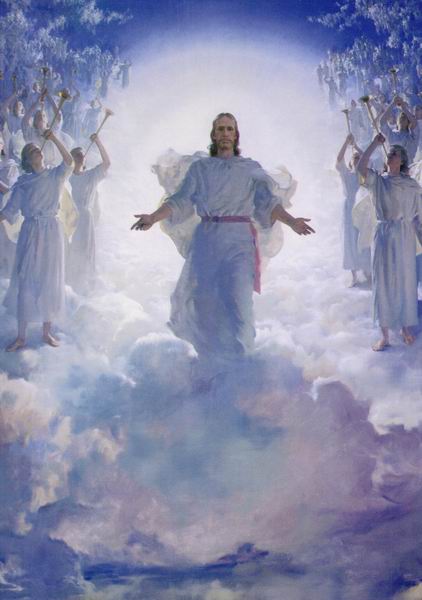 If you have a problem with a commandment, test God and sincerely try living it and see if he doesn’t pour you out a blessing, I dare you.
“If there is a God, why would he let bad things happen to good people?” The questions are endless. If you want answers to all these thousands of questions that cause unbelief or keep you from trying to live a Christ-like life style, I do not have time to answer all of them here. It’s purely about risk. What do you stand to lose if you live as if there is no God, and turns out there is a God, and he is the God of the Christian Scriptures? What will you do when you meet him unprepared, covered in mud? Do you really think you’ll just feel comfortable in his presence knowing you could have done your part? Do you think it right to receive God’s reward?

 Just Another LDS Voice